Pre-Owned Hybrid vs Pre-Owned Electric Car: Best BMW Options in BC
Pre-Owned Hybrid vs Pre-Owned Electric Car: Best BMW Options in BC
Posted on June 14, 2026
Fuel prices, growing EV adoption, and expanding charging infrastructure have changed how many BC drivers shop for pre-owned luxury vehicles. For many buyers, the decision comes down to practicality.
A used BMW hybrid keeps gasoline flexibility while reducing fuel consumption. A used BMW EV can reduce or eliminate regular fuel stops, but charging access, winter driving conditions, and battery range become more important parts of ownership.
Driving habits often determine which option makes more sense. A Downtown Vancouver commuter with home charging may lean toward a fully electric BMW, while a driver regularly travelling outside Metro Vancouver may prefer the flexibility of a hybrid or plug-in hybrid.
Commuting distance, home charging access, winter travel, and highway driving all affect whether a used BMW hybrid or used BMW EV feels more practical for BC ownership.
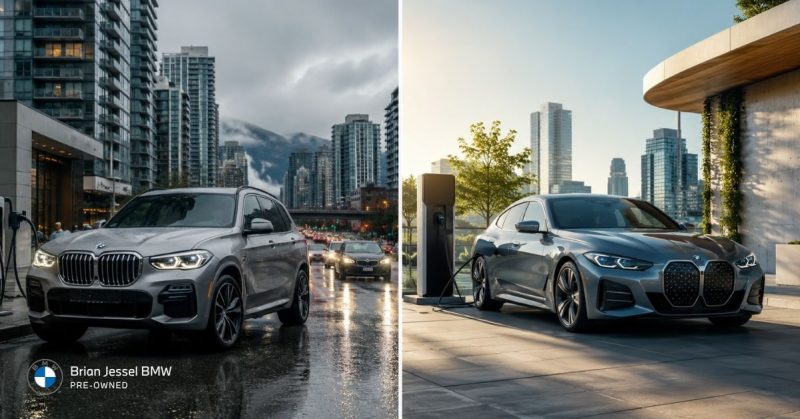
Used BMW Hybrid vs Used BMW EV: What’s the Difference?
A traditional hybrid uses both a gasoline engine and an electric motor. The battery charges automatically through regenerative braking and engine operation, so drivers never need to plug the vehicle in.
A plug-in hybrid electric vehicle, or PHEV, also combines a gasoline engine and electric motor, but with a larger battery that can be charged externally. BMW Canada states that plug-in hybrids can be charged through a public charging station or BMW Wallbox at home, and when the high-voltage battery is depleted, the vehicle switches to its combustion engine.
A fully electric vehicle removes the gasoline engine entirely and relies on a high-voltage battery and electric motors. BMW’s electric lineup includes models such as the i4, i5, i7, and iX.
The biggest ownership difference comes down to fuelling and charging habits. A hybrid still depends on gasoline, while a plug-in hybrid can reduce fuel use if charged regularly. A full EV depends much more on charging access and available battery range.
Used BMW Hybrid vs BMW EV: Which One Offers Better Performance?
A used BMW EV usually feels quicker in city driving because electric motors deliver torque immediately. That instant response can feel noticeable in Vancouver traffic, short merges, and low-speed commuting.
A used BMW hybrid or plug-in hybrid feels more familiar to drivers moving from a conventional BMW. The electric motor supports acceleration, while the gasoline engine keeps longer-distance flexibility.
Winter Performance in BC
Cold weather can affect EV range. BMW Canada notes that electric range may vary based on driving habits and other factors, while model pages also note that range can vary depending on outside temperature, driving style, route, and use of heating or air conditioning.
This matters for BC drivers regularly travelling through colder areas such as the Coquihalla, Sea-to-Sky corridor, or Interior BC during winter months.
Hybrids are also affected by cold weather, but they are less dependent on battery range during long-distance winter travel.
Used BMW Electric vs BMW Hybrid: Which Is Better for Vancouver Driving?
Vancouver traffic conditions often suit electrified vehicles. Frequent braking, slower speeds, and shorter commuting distances help EVs recover energy through regenerative braking. A used BMW EV may suit drivers spending most of their time within Vancouver, Burnaby, Richmond, or North Vancouver. Quiet operation and fewer fuel stops can make daily commuting easier.
A used BMW hybrid may work better for buyers who drive longer distances regularly or do not have consistent charging access.
Keep Reading: Should You Buy a Used BMW EV in Vancouver
Condo Charging and Apartment Living
Charging access remains one of the largest deciding factors between a used BMW electric vs BMW hybrid. Homeowners with private parking generally have a simpler transition into EV ownership because Level 2 charging can often be installed at home.
Condo owners may face additional steps involving strata approval, electrical upgrades, or shared charging systems.
BC Hydro currently offers rebate programs for EV Ready plans, electrical infrastructure, and charger installation in apartments, condos, and townhomes, with pre-approval required before purchase and installation.
For buyers without dependable charging access, a plug-in hybrid may feel easier to manage than a fully electric vehicle.
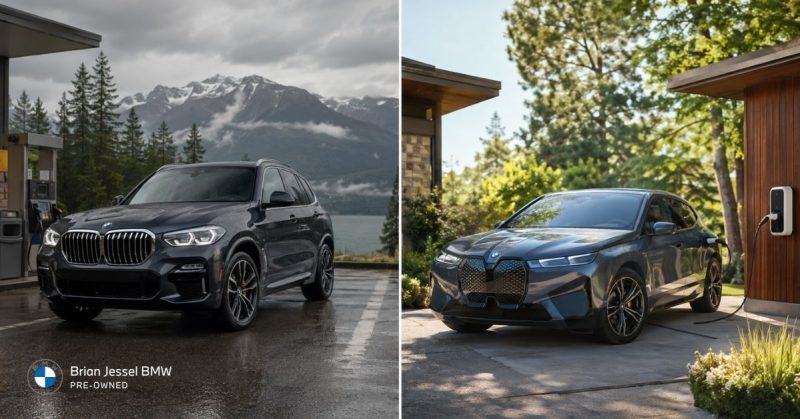
Pre-Owned Hybrid vs Pre-Owned Electric Car: Which Costs Less to Own?
Operating costs depend on driving habits, annual mileage, charging access, and the specific BMW model. A used BMW EV can reduce day-to-day energy costs when charged mainly at home. As of May 1, 2026, the BCUC lists BC Hydro residential tiered rates at $0.1187/kWh for Step 1 and $0.1408/kWh for Step 2.
EV ownership is not automatically cheaper in every situation. Public fast charging costs more than residential charging, and EV tire wear may be higher due to vehicle weight and instant torque.
A used BMW hybrid still requires gasoline, but many buyers value the flexibility of refuelling anywhere without depending on charging infrastructure.
Used BMW Hybrid vs Used BMW EV Cost and Ownership Comparison
Both options can lower fuel use compared with traditional gasoline vehicles, but cost differences depend on charging access, commuting habits, and long-distance driving needs.
| Ownership Category | Used BMW Hybrid / PHEV | Used BMW EV |
| Fuel Or Electricity Costs | Lower Fuel Use Than Gasoline-Only Vehicles | Lower Energy Costs When Charged at Home |
| Public Charging Costs | Limited Importance for Hybrids | Important For Road Trips and Condo Owners |
| Oil Changes | Required | Not Required |
| Brake Wear | Reduced Through Regenerative Braking | Often Reduced Further Through Regenerative Braking |
| Tire Wear | Moderate Depending on Model and Driving Style | May Increase Because EVs Are Heavier |
| Insurance Costs | Depends On Model and Coverage | Depends On Model Value and Repair Costs |
| Battery Considerations | Smaller Battery System | Larger Battery System with Greater Long-Term Importance |
| Home Charging Setup | Helpful For PHEVs | Strongly Recommended for EVs |
Pre-Owned BMW Hybrid vs BMW EV Maintenance Costs
BMW hybrids still require conventional engine-related servicing such as oil changes, filters, spark plugs, and cooling-system maintenance over time.
BMW EVs remove many engine-related service items but still require brake servicing, tire replacement, suspension inspections, software updates, and battery cooling-system checks.
BMW Canada also notes that plug-in hybrids can have lower maintenance costs than traditional gasoline vehicles because regenerative braking helps reduce brake wear and the combustion engine runs less often.
BMW-Certified Servicing Matters
Electrified BMW models use high-voltage systems that should be inspected by trained technicians. Brian Jessel BMW Pre-Owned is a pre-owned BMW dealership in Vancouver and allows shoppers to browse inventory, request information, set up test drives, and ask about financing.
For used EV buyers, battery-condition inspections, charging-system checks, and service-history reviews are especially important before purchase.
Learn More: How Often Should a BMW Be Serviced
Used BMW Hybrid vs Used BMW EV Battery Life and Warranty
Battery condition is one of the most important considerations when shopping for a used BMW EV.
BMW Canada states that for battery electric vehicles, the lithium-ion high-voltage battery is covered against defects in materials and workmanship under the New Vehicle Limited Warranty for 8 years or 160,000 km, whichever occurs first. BMW notes this applies to latest-generation electric models such as the BMW iX or BMW i5.
BMW Canada warranty materials also note that battery warranty coverage may vary depending on model year and generation, so used buyers should confirm coverage by VIN.
Battery aging depends on mileage, charging habits, climate, storage conditions, and fast-charging frequency. A vehicle charged mostly at home on Level 2 may age differently from one repeatedly fast charged during highway travel.
Before purchasing a used BMW EV, buyers should confirm battery warranty status, service history, charging performance, and software updates.
Learn More: Should You Buy an Extended Warranty for a Used BMW?
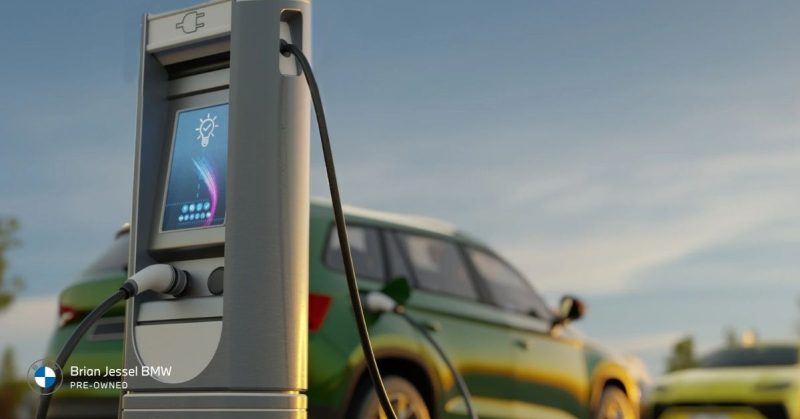
Charging a Used BMW EV in Vancouver and BC
Charging convenience depends heavily on parking access and driving habits. Level 1 charging uses a standard household outlet and charges slowly. Level 2 charging uses a 240V setup and is usually preferred for daily EV ownership because it can recharge the vehicle overnight.
BMW Canada also promotes home charging through Level 2 BMW Flexible Fast Charger or BMW Wallbox solutions. DC fast charging is more useful for longer-distance travel and highway charging stops.
Public Charging Across BC
British Columbia reported more than 8,800 public charging ports province-wide as of January 2026, including Level 2 and DC fast chargers across Metro Vancouver, Vancouver Island, and major BC travel routes. 1
As of early 2026, BC Hydro had introduced 400-kW fast chargers at BCIT’s Burnaby campus and reported surpassing 800 public charging ports in its network. 2
Even with better infrastructure, charging convenience still varies depending on weather, route planning, charger availability, and seasonal traffic.
BMW drivers can also benefit from BMW’s connected charging ecosystem through the My BMW app, which can help locate compatible charging stations, monitor charging sessions, and assist with route planning. Buyers considering a used BMW EV should confirm the charging capabilities and software features available on the specific model year they are considering, as charging technology and connectivity features have evolved significantly across BMW’s electric lineup.
Used BMW Hybrid vs Used BMW EV for Long-Distance BC Driving
Long-distance travel is where ownership differences become more noticeable. A used BMW hybrid or plug-in hybrid may feel easier for drivers regularly travelling across BC because gasoline refuelling remains faster and more widespread than EV charging.
A used BMW EV can still work well for longer trips, especially newer models with larger batteries and faster charging capability. BMW Canada currently lists the BMW i4 eDrive40 Gran Coupé at up to 512 km of range under Government of Canada approved testing methods.
Recent BMW iX models can offer more than 500 km of estimated driving range depending on trim and configuration. BMW also equips the iX with DC fast-charging capability designed to reduce charging times during longer-distance travel.
Real-world range still changes based on weather, terrain, speed, wheel size, and battery condition.
Which Used BMW Electrified Vehicle Is Best for Your Lifestyle?
A used BMW EV may suit Downtown Vancouver commuters with reliable home or workplace charging and predictable driving distances.
A plug-in hybrid may suit suburban families or drivers regularly travelling outside Metro Vancouver who still want gasoline flexibility.
Condo owners should carefully confirm charging access before choosing a fully electric vehicle.
Long-distance drivers should compare charging convenience, winter travel needs, and highway driving habits before deciding between a hybrid and EV.
Used BMW Hybrid vs Used BMW EV Pros and Cons
The main trade-off is convenience. Hybrids keep gasoline flexibility, while EVs depend more on charging access and battery condition.
| Vehicle Type | Advantages | Considerations |
| Used BMW Hybrid | Familiar Refueling, Reduced Fuel Use, Easier Long-Distance Travel | Still Requires Gasoline and Engine Maintenance |
| Used BMW Plug-In Hybrid | Electric Commuting with Gasoline Backup | Savings Depend on Consistent Charging |
| Used BMW EV | No Gasoline, Quieter Operation, Fewer Engine-Related Service Items | Charging Access and Battery Condition Matter More |
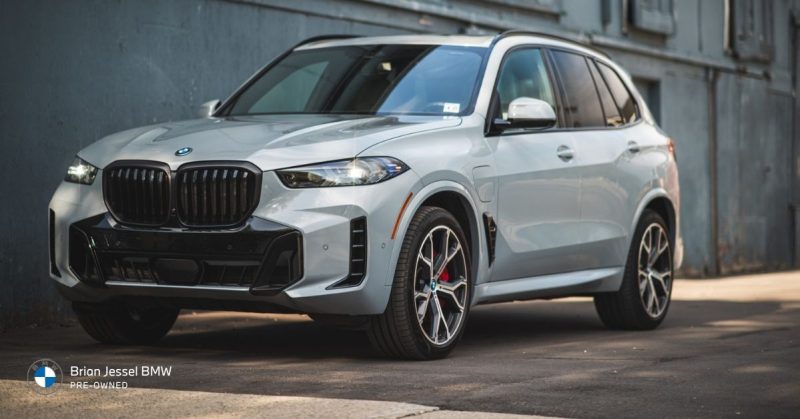
Best Pre-Owned BMW Hybrid Models for BC Buyers
BMW’s plug-in hybrid lineup gives BC drivers lower fuel consumption for city commuting while still keeping gasoline flexibility for longer highway travel.
BMW 330e
The BMW 330e suits commuters looking for lower fuel consumption while keeping the handling and driving feel of a compact BMW sport sedan. The BMW 330e xDrive is commonly associated with BMW’s electrified 3 Series lineup and may appear in Vancouver-area pre-owned inventory.
The 330e can be especially appealing for drivers with shorter daily commutes who can charge regularly at home or work. Many owners use the electric driving capability for local trips while relying on the gasoline engine for longer drives outside Metro Vancouver. It often appeals to young professionals, downtown commuters, and first-time BMW hybrid buyers who want lower fuel consumption without changing their driving habits significantly.
BMW X5 xDrive45e / X5 xDrive50e
Used shoppers may see older X5 xDrive45e models, while BMW Canada’s current X5 plug-in hybrid is the xDrive50e. BMW Canada lists the current X5 plug-in hybrid with up to 64 km of electric range on battery power alone. The X5 plug-in hybrid may suit families wanting SUV practicality, quieter city driving, and gasoline flexibility for longer BC road trips.
Its larger size, cargo capacity, and available luxury features make it attractive for buyers who regularly travel with passengers, sports equipment, or luggage. Drivers who divide their time between Vancouver commuting and longer trips to Whistler, Vancouver Island, or the Interior may appreciate the balance between electric driving and traditional refuelling convenience.
BMW 530e
The BMW 530e combines plug-in hybrid efficiency with a larger luxury sedan layout focused on commuting comfort and highway stability.
It may appeal to professionals who spend significant time travelling between Vancouver, Burnaby, Richmond, Surrey, North Vancouver, or the Fraser Valley. Compared with the 330e, it offers additional interior space and a more relaxed highway-driving experience while still providing plug-in hybrid efficiency benefits for shorter daily trips. Buyers who prioritize comfort, refinement, and executive-sedan practicality may find it a strong alternative to BMW’s smaller sedans.
BMW X3 xDrive30e
The X3 xDrive30e may appear in Canadian pre-owned inventory, although it is not part of BMW Canada’s current new X3 lineup. It may suit buyers wanting SUV practicality and plug-in hybrid flexibility for mixed city and highway driving.
For many BC buyers, the X3 plug-in hybrid occupies a useful middle ground between the 330e and X5 plug-in hybrid. It offers easier manoeuvrability than a larger SUV while still providing cargo flexibility, available all-wheel-drive capability, and a higher seating position. It may be particularly attractive to small families, North Shore commuters, and buyers who want one vehicle capable of handling both city errands and weekend travel.
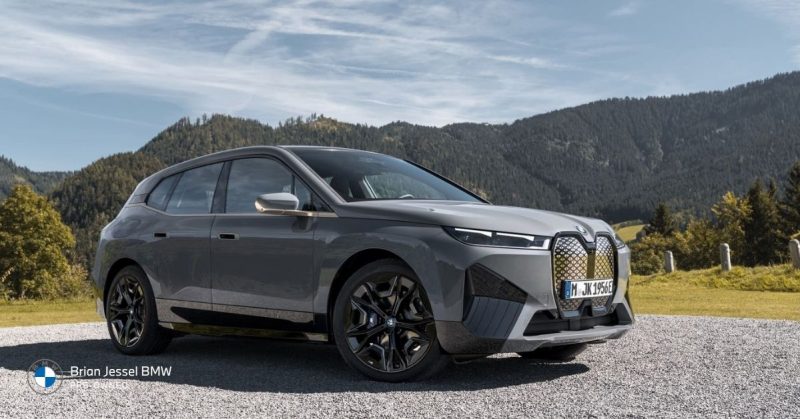
Best Pre-Owned BMW EV Models for Vancouver and BC Driving
BMW’s EV lineup covers different driving needs, from city commuting to larger electric SUVs and highway travel. Range, charging speed, winter performance, and daily driving habits can all influence which BMW EV feels more practical for BC ownership.
Buyers should also recognize that BMW EV technology has evolved significantly over the past decade. Earlier models such as the BMW i3 were designed primarily for urban driving and generally offer shorter driving ranges and slower charging capabilities than newer BMW EVs. More recent models such as the i4 and iX provide substantially longer range, faster charging speeds, more advanced battery management systems, and updated software features. Comparing model year, charging capability, and battery specifications is often just as important as comparing the vehicle itself.
BMW i4
BMW Canada lists the BMW i4 eDrive40 Gran Coupe with up to 512 km of range under Government of Canada approved criteria and testing methods. The i4 may suit drivers moving from a BMW 3 Series or 4 Series into EV ownership while still wanting familiar sedan-style handling, quiet operation, and strong commuting range.
BMW iX
Recent BMW iX models may appeal to families and luxury SUV buyers wanting interior space, highway comfort, and longer-range electric driving. Available configurations offer multiple battery and performance options, with higher-trim models capable of exceeding 500 km of range under ideal conditions.
BMW i3
The BMW i3 remains one of the more accessible BMW EV entry points for buyers interested in urban electric driving. Buyers should still review battery condition, winter range expectations, and charging capability carefully before purchase.
BMW i7
The BMW i7 focuses on luxury, rear-seat comfort, quiet highway driving, and advanced technology features. Used shoppers should verify model year, trim, battery condition, and official Canadian range by VIN or BMW Canada listing before purchase.
Key Considerations When Choosing a Used BMW Hybrid vs Used BMW EV
Charging access, commuting habits, winter driving, and long-term ownership costs can all affect whether a hybrid or EV feels more practical for BC drivers.
Charging Access
Charging access should always be confirmed before purchasing a used EV, especially for condo owners, apartment residents, or drivers without dependable overnight parking access and consistent access to nearby public charging stations.
Driving Habits
Daily commuting distance, long-distance travel frequency, highway driving, and winter travel patterns can all affect whether a hybrid or EV feels more practical for BC ownership and year-round driving conditions.
Battery Health
Battery-condition inspections should include warranty review, charging performance, software updates, service history, and overall battery-system health before purchasing a used BMW EV or plug-in hybrid vehicle in BC.
Long-Term Value
Newer EVs generally provide better charging speeds, improved battery management, longer driving range, and updated software systems compared with earlier BMW EV models currently available in pre-owned inventory.
Maintenance Expectations
Hybrids still require gasoline-engine servicing and fluid maintenance, while EV ownership shifts maintenance attention more heavily toward tires, brakes, charging systems, software updates, and battery-cooling system inspections.
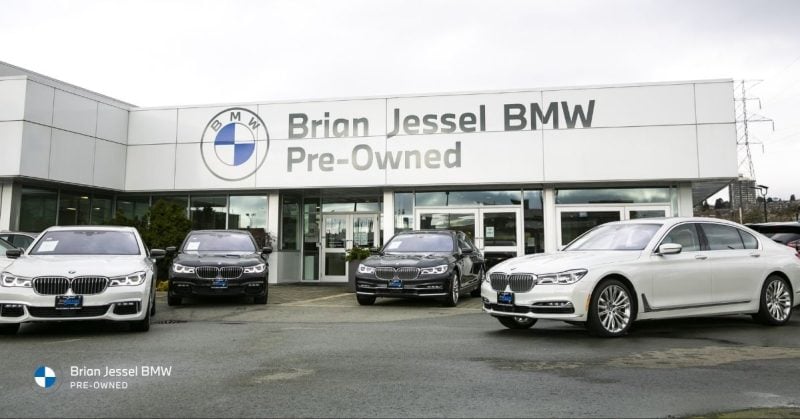
Why Buying a Pre-Owned BMW Hybrid or EV From a BMW-Focused Dealership Matters
Buying a used electrified BMW involves more than checking mileage and appearance. Battery condition, software status, charging-system performance, service history, and inspection quality all affect ownership.
Brian Jessel BMW in Vancouver provides BMW-focused sales and servicing support for drivers shopping for electrified BMW models.
For first-time EV buyers especially, discussing charging access, winter driving, commuting habits, and maintenance expectations with BMW-trained staff can make the decision easier and more realistic.
FAQs
1. Is a used BMW EV worth buying?
A used BMW EV may suit drivers with dependable charging access, predictable commuting distances, and verified battery-condition information.
2. Are BMW hybrids reliable?
BMW hybrids can provide dependable ownership when maintained properly and serviced consistently.
3. How long do BMW EV batteries last?
BMW Canada states that latest-generation BMW EV batteries are covered for up to 8 years or 160,000 km depending on warranty terms.
4. Is charging difficult in Vancouver?
Charging convenience depends heavily on housing type, parking access, and nearby charging infrastructure.
5. Which is cheaper to maintain: hybrid or EV?
EVs remove many engine-related maintenance items, while hybrids still require traditional engine servicing.
6. What happens if an EV battery degrades?
Battery degradation gradually reduces available driving range over time.
7. Is a plug-in hybrid better than a fully electric BMW?
That depends on charging access, commuting habits, and long-distance driving needs.
8. Should I buy a used EV from a dealership?
A BMW-focused dealership can help review battery condition, service history, warranty status, and charging-system health.
9. Which used BMW electrified model has the best range?
Among commonly available BMW EVs, newer i4 and iX models generally provide substantially more driving range than older BMW i3 models. Exact range depends on model year, trim, wheel size, temperature, battery condition, and driving style.
Explore More: Used BMW 2023 in vancouver, Used BMW 2024 in vancouver, Used BMW 2025 in vancouver, Used BMW SUVs, BMW Used Sedan, Used SUVs for Sale